
This edition of the siliconeoil industry brief follows the surfactant chain from high-value end markets and new capacity to low-carbon rigid-foam systems and catalyst chemistry. Four items are drawn from material published or updated between 18 and 25 November 2026, with the newest conference report issued today. Supplier advertisements, quotations, telephone numbers, instant-messaging contacts and QR codes have been excluded, and source names appear as plain text.
Cell control remains the core function of foam stabilisers even as demand shifts to higher-value applications. (Original illustration)
1. Silicone Suppliers Chase High-Value Windows in Humanoid Robots and the New Power System
1. Summary: A report published today by China Industrial Economic Information Network, reprinted from China Chemical News, looks at where China’s silicone sector can find growth after two decades of capacity expansion. At the fourth Organic Silicon Industry Innovation Development Conference, Zhang Hailiang, deputy director of the materials industry institute at the CCID Academy, said humanoid robots are moving from prototype displays toward volume production and that material selection has not yet been fixed. Once an original-equipment manufacturer locks a specification, supply-chain patterns are hard to change, he noted, drawing a parallel with battery materials. A single humanoid robot is expected to consume about 7.5 kilograms of silicone, mostly high-end grades. Silicone rubber outperforms thermoplastic elastomers in high- and low-temperature resistance and ageing, with uses in bionic skin, flexible sensing, sealing and damping, and thermal interfaces. For bionic skin, silicone is more durable than thermoplastic polyurethane but costs more, so the two are likely to coexist by component rather than one replacing the other. Tsinghua University professor Liang Xidong argued that the real headroom in the new power system lies in reliability rather than tonnage. Around three trillion kilowatt-hours of incremental electricity implies extensive ultra-high-voltage and distribution construction, pulling composite and station insulators, cable accessories and anti-pollution coatings. Power electronics modules are designed for 30 to 40 years but remain limited by packaging and heat removal; transformer buyers need clearer performance boundaries between silicone oil and mineral or vegetable oils; sulphur hexafluoride replacement is inevitable while vacuum and alternative-gas routes remain unsettled; and storage capacity is set to double within five years with different insulation demands by voltage class. Zhang Lidian of the Ministry of Industry and Information Technology said support during the 15th Five-Year Plan period will cover research, industrialisation and application promotion, including revised guidance for first-batch application of new materials.
2. Source: China Industrial Economic Information Network, citing China Chemical News, 25 November 2026, reporting on the fourth Organic Silicon Industry Innovation Development Conference. Organisational and contact text removed.
3. Editor’s Pick + Reason: A defined 7.5-kilogram high-grade silicone content per robot, before supply chains lock. Reason: It reframes growth as specification qualification rather than tonnage, the same shift facing foam stabiliser and catalyst suppliers moving into electric vehicles, electronics and robotics.
2. Surfactant and Silicone Oil Capacity Adds Up in Lianyungang as Shenzhen Land Goes to Electronic-Grade Silicones
1. Summary: Shanghai Metals Market reported on 18 November that the Yuyang surfactant and silicone oil project broke ground in the Lianyungang chemical industry park. Built by Yuyang New Materials, the project carries total investment of 600 million yuan and will be delivered in two phases. Earlier environmental documentation sets planned capacity at 45,000 tonnes per year of surfactants and 20,000 tonnes per year of silicone oil, with 30,000 tonnes per year of sodium acetate solution as a byproduct. At full operation the site is expected to generate 800 million yuan in annual sales and 50 million yuan in tax revenue, and its output can be supplied directly to neighbouring plants in the park. On 23 November, Southern+ reported that three industrial parcels exceeding 60,000 square metres in total were transferred in the Shenshan Special Cooperation Zone. Parcel E2026-0027, covering about 26,700 square metres inside the high-end electronic chemicals park, was won by Shenzhen Senri Organic Silicon Materials for an electronic-grade liquid silicone rubber and additives project covering electronic-grade silicone rubber, silicone additives and ammonium sulphate. A commodity note dated 25 November lists DMC at 12,800 yuan per tonne and notes that organosilicon producers are intensifying output cuts, with dry-season reductions in Sichuan and Yunnan and only a partial restart at large Xinjiang plants late in the month. The two capacity stories point in different directions: generic surfactant and silicone oil scale in the north, electronic-grade specialisation in the south.
2. Source: Shanghai Metals Market, 18 November; Southern+, 23 November; Tonghuashun Finance commodity note, 25 November 2026. Promotional language and contact details removed.
3. Editor’s Pick + Reason: 45,000 tonnes of surfactant and 20,000 tonnes of silicone oil in a single park. Reason: New volume on the generic side pressures standard foam-stabiliser grades, while the electronic-grade land deal shows where margin is moving; buyers should expect diverging economics across grade families.
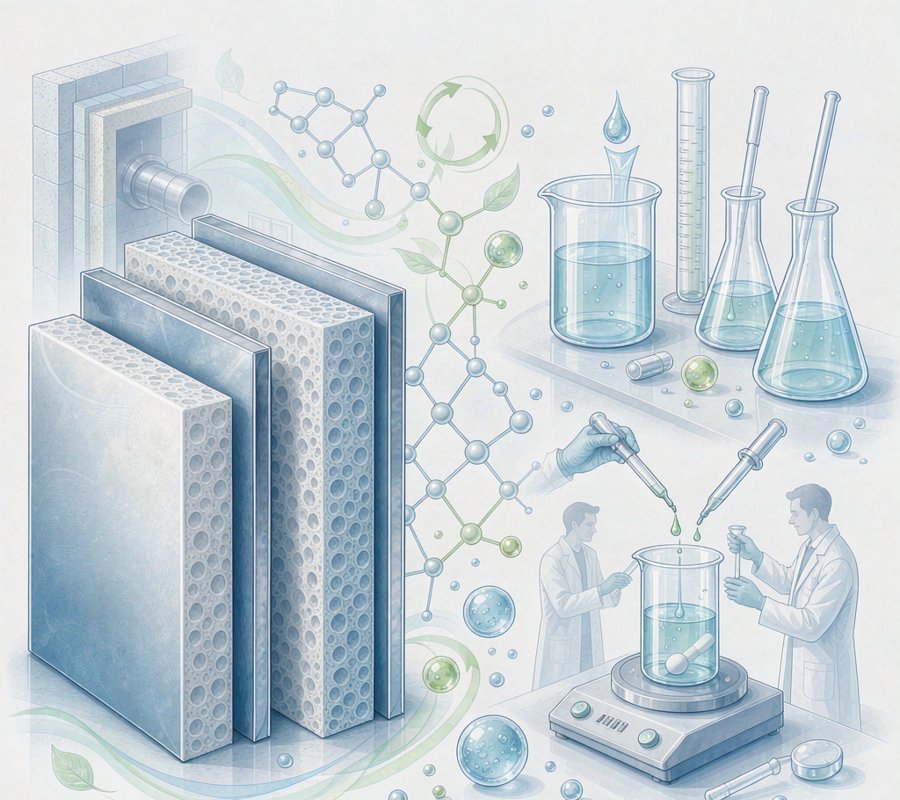
Low-carbon rigid systems pull silicone stabilisers and catalyst packages into the specification. (Original illustration)
3. Yinuowei Starts a 200,000-Tonne Low-Carbon Rigid Foam Polyether Line
1. Summary: Zibo News reported on 22 November that Shandong Yinuowei holds the world’s largest share of polyurethane elastomers. Its rail-pad elastomer took 18 months and more than 300 formulation trials to develop, tolerates temperatures from minus 40 to 60 degrees Celsius, improves fatigue resistance by 30 percent and costs 31 percent less than imported material. In October the company completed the third phase of its new-materials programme, covering 175.77 mu with total investment of 841 million yuan. The phase includes a 300,000-tonne-per-year propylene oxide and ethylene oxide downstream derivatives project and a 200,000-tonne-per-year low-carbon environmentally friendly rigid polyurethane combination polyether project. Yinuowei says the new catalyst system and process raise production efficiency by more than 20 percent over conventional routes and cut waste gas, wastewater and residue by more than 40 percent; annual sales are expected to reach 5.5 billion yuan at full ramp. The company has completed a blowing-agent substitution programme and holds bio-based polyol and low-VOC products in its portfolio, with finished-product carbon footprint reported 30 percent below conventional processing. Rigid combination polyether is the carrier system for rigid-foam silicone oil, foam catalysts and blowing agents, so large low-carbon capacity additions pull stabiliser and catalyst demand along with them rather than replacing it.
2. Source: Zibo News, 22 November 2026. Corporate promotional language removed.
3. Editor’s Pick + Reason: 200,000 tonnes of rigid combination polyether paired with a 30 percent carbon-footprint claim. Reason: Suppliers of rigid-foam silicone oil and catalysts will increasingly be asked to show how their packages contribute to that footprint figure, turning low-GWP blowing agents and low-odour catalysts into specification items.
4. Low-Odour Formulation Shifts from Amine Reduction to Catalyst-Chemistry Switches
1. Summary: A polyurethane additive market board dated 24 November, read alongside recent technical references, shows why low-odour design is no longer a simple matter of dosing less amine. The board lists dimethyl silicone oil ex works at 15,000 to 17,000 yuan per tonne, flexible-foam stabiliser silicone oil at 10 to 37.5 yuan per kilogram, imported silicone oil at 18,500 to 20,000 yuan per tonne, solid triethylenediamine at 35,000 to 45,000 yuan per tonne, A33 in liquid and solid forms at 16.9 to 100 yuan per kilogram, and stannous octoate near 95,000 to 96,000 yuan per tonne, with combined organotin and specialty-amine expansion of roughly 32,300 tonnes per year. Technical notes explain that DMDEE carries two morpholine rings plus ether linkages, giving low volatility and a bias toward the water-isocyanate blowing reaction. TMPDA is a dual-action tertiary amine balancing gel and blow with relatively low odour, suited to high-resilience flexible foam, moulded foam and rigid systems. A further review from the polymer foaming materials technology community reports that copper-amine complexes can replace Dabco EG with comparable gel activity and higher blowing activity, representing a change of catalyst chemistry rather than a cut in quantity, although cost, regulatory status and product colour still require industrial validation. For formulators, the practical consequence is that odour-compliant systems depend on matching catalyst chemistry with the cell-opening and gelation window of the silicone surfactant, which has to be confirmed in trial work.
2. Source: Polyurethane Additives Price and Market Analysis, 24 November 2026; ChemicalBook technical entries for DMDEE and TMPDA, updated 18 November; Polymer Foaming Materials Industry Technology Network, November 2026. Quotations, supplier promotions and contact details removed.
3. Editor’s Pick + Reason: Copper-amine complexes and dual-action amines replacing the “use less amine” playbook. Reason: It moves the low-odour debate from dosage to mechanism, making surfactant-catalyst rebalancing and small-scale trials the practical route to interior-grade foam.
Compiled 25 November 2026. Illustrations are original, AI-generated, free of third-party licensing claims and free of watermarks. Dates and times refer to GMT+8.