
This edition of the siliconeoil industry brief tracks the surfactant and additives chain from the first full-landscape Chinese stabiliser white paper to low-GWP pre-mix blowing, near-zero-VOC high-resilience silicone oils and fine-cell flame-retardant sponge technology. Four items are drawn from material published or updated on 17 November and over the past two weeks. Supplier advertisements, promotional price lists, telephone numbers, instant-messaging contacts and QR codes have been excluded, and source names appear as plain text.
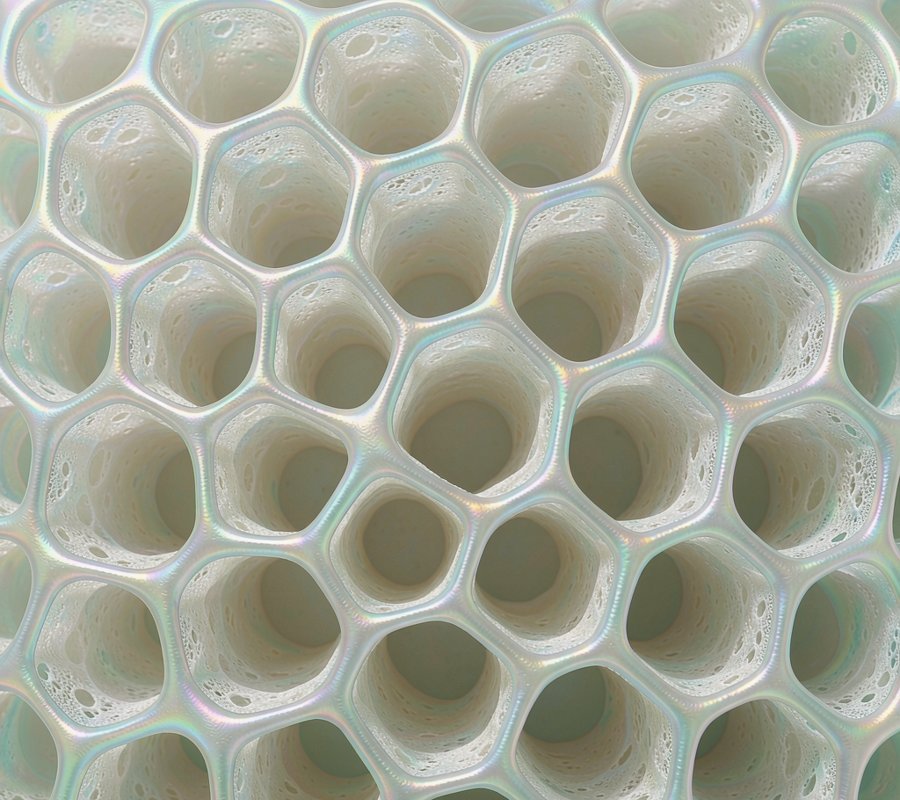
Cell opening and near-zero-VOC control are reshaping high-resilience slabstock. (Original illustration)
1. First-Ever Foam Stabiliser White Paper Puts Bio-based Grades on the Industry Agenda
1. Summary: The China Polyurethane Foam Stabiliser Industry Development White Paper (2026), compiled jointly by the China Polyurethane Industry Association and Meiside Chemical, was released during PU China 2026 in Shanghai on 3–5 November. It is described as the first full-landscape white paper for the foam-stabiliser segment, mapping the sector’s history, current structure and unresolved problems, and offering a development guide for the 15th Five-Year Plan period. At the accompanying roundtable on China and global polyurethane opportunities, Meiside chairman Sun Yu joined heads of the European flexible-foam association and the Chinese association to discuss global realignment, the green-low-carbon transition and chain collaboration. In an interview, Sun said domestic mid-to-low-tier additive capacity is ample while high-end products remain in short supply. At the show Meiside launched two silicone stabilisers — an ultra-low-conductivity rigid-foam grade for appliance and cold-chain insulation and a compression-resistant flexible-foam grade for exported roll-packed mattresses — and said it is prioritising a new generation of bio-based stabilisers. The company urged leading firms to compile similar segment white papers so upstream and downstream players share a clear view of capability boundaries and demand directions.
2. Source: China Chemical Industry News (ccin.com.cn), “Meiside shares industry thinking at the international polyurethane exhibition”, 11 Nov 2026; Sina Finance green-innovation feature, 11 Nov 2026.
3. Editor’s Pick + Reason: The industry’s first full-landscape white paper for foam stabilisers. Reason: It moves a fragmented additive segment from price-led competition toward documented capability boundaries and demand directions, giving formulators a shared reference for qualifying high-end and bio-based grades instead of relying on supplier claims alone.
2. Near-Zero-VOC High-Resilience Silicone Oil and Low-Odour Systems Target Comfort Foam
1. Summary: A product specification updated 17 November for TEGOSTAB B8707 LF2 positions a high-resilience slabstock silicone oil for all HR slabstock and MDI-based viscoelastic foam. The listing claims almost zero contribution to volatiles in a sealed-container test at room temperature, together with controlled cell and open-cell behaviour, a wide processing tolerance and no phthalates, at a typical addition of 0.3 to 1.0 parts. At PU China 2026, Momentive showed its NIAX high-performance flame-lamination additive for polyether foam, described as environmentally friendly and low-emission, delivering polyester-like lamination with higher yield and reduced halogenated flame-retardant use, plus a boxed-mattress and compressed-sofa system with compression-set resistance, low odour and low emissions. Jiahua Chemicals presented a memory-foam platform with recovery time adjustable from 2 to 10 seconds, 99 percent recovery within 10 minutes of roll-pack compression testing, and tunable breathability and zoned designs. Aosijia displayed high-resilience, slow-recovery and anti-compression silicone oils, sponge softeners and low-odour catalysts for automotive seating.
2. Source: China.cn product specification page updated 17 Nov 2026 (technical data only; quotations and contact details removed); PUdaily PU China 2026 opening-day report, 4 Nov 2026.
3. Editor’s Pick + Reason: The near-zero-VOC sealed-container claim paired with a wide processing tolerance for HR slabstock. Reason: It couples an emissions metric to a robustness metric, showing that low-odour chemistry is being engineered to survive real line variation rather than to pass a laboratory test only.
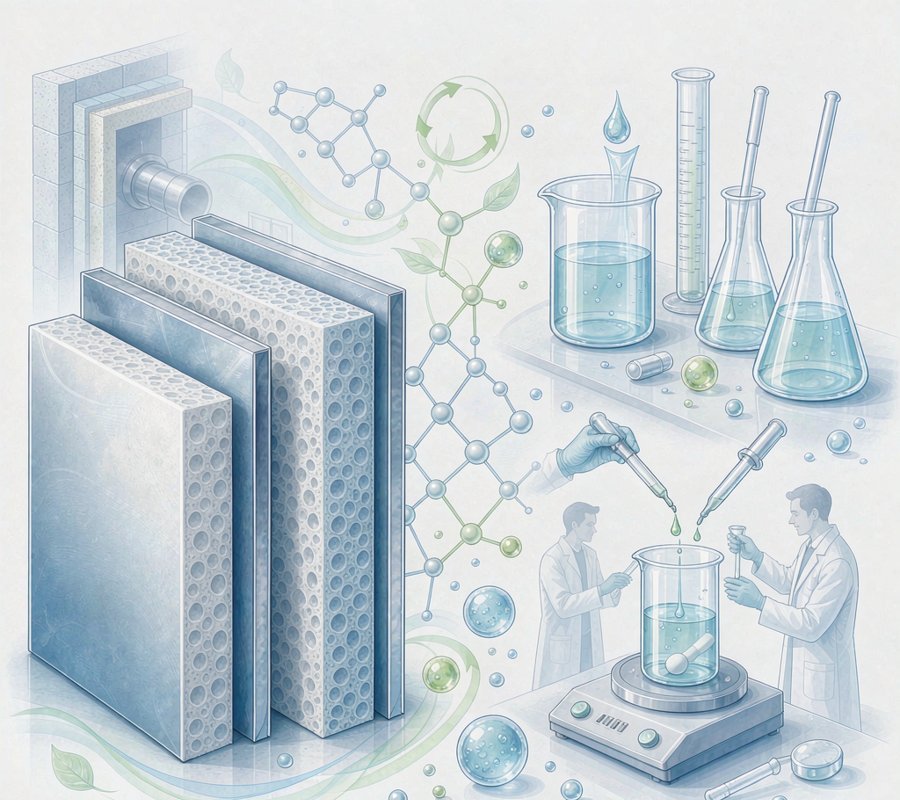
Low-GWP blowing and phosphorus-silicone systems are converging in rigid insulation. (Original illustration)
3. Low-GWP Pre-mix Blowing and Phosphorus-Silicone Integration Redefine Rigid Foam
1. Summary: Hebei Yadong Chemical Group presented a fluorine-free, low-GWP, ultra-low-conductivity rigid-foam white-component pre-mix process. By combining jet dynamic mixing with circulating pre-mix, the route micro-emulsifies the blowing agent into the polyol, adding nucleation sites and lowering lambda; measured results show thermal conductivity down 5 percent and large-cell count down more than 50 percent, with systems for refrigerators, water heaters and building spray foam. Meiside showed spray additives M-88207 for HFO formulations and M-88558 for next-generation eco-friendly blowing agents, plus amine catalysts for high-water/245fa and HFO systems. Wynca’s Fujian Xin’an and Chongyao units presented an integrated phosphorus-flame-retardant plus silicone-additive platform: WynPh TCPP and halogen-free WynPh TEP with low smoke and low toxicity, alongside the WynPUF full surfactant range, XH-1641 low-conductivity appliance silicone oil that refines cells, and XH-2596N with R150 compression-resistant package for fast rebound and lower block density gradient. Sikorui showed B1-grade flame-retardant polyester polyol for high-retardant exterior-wall and cold-storage insulation. With HCFC-141b now fully phased out, HFO, HFC-245fa and all-water systems are forcing catalyst packages to be re-qualified.
2. Source: PUdaily and chem366 PU China 2026 day-two reports, 5 Nov 2026; Sina Finance report on Wynca, Fujian Xin’an and Chongyao, 6 Nov 2026.
3. Editor’s Pick + Reason: The measured 5 percent lambda reduction and more than 50 percent cut in large cells from pre-mix micro-emulsification. Reason: These are production-line numbers, not a sustainability slogan, and they explain why catalyst and stabiliser suppliers are being pulled into joint trials with white-component premixers instead of selling into a fixed recipe.
4. Fine-Cell and Closed-Cell Routes Define the Next Flame-Retardant Sponge Wave
1. Summary: A 2026 technology outlook on flame-retardant sponge traces the shift away from halogen systems toward phosphorus-nitrogen synergy, nano-modified inorganic retardants and bio-based carriers. Phosphorus-nitrogen systems build a dense char layer that isolates oxygen and heat without toxic halogen release, while nano-silica, montmorillonite clay and carbon nanotubes improve dispersion and interface bonding in the polymer matrix, regulating pore size and lowering conductivity. Supercritical CO2 or nitrogen foaming produces uniform cells and high closed-cell ratios, with fine closed cells of 10 to 50 micrometres and closed-cell content above 90 percent, avoiding ozone-depleting blowing agents and chemical residues. On the additive side, chemical modification of silicone oil with phosphate groups gives phosphorus contents of 5 to 8 percent and a limiting oxygen index above 30 percent, while nitrogen-phosphorus synergy reaches 32 to 35 percent. Viscosity of 500 to 2000 centipoise matches polyurethane forming; above 3000 centipoise foaming becomes uneven. Solvent-free synthesis in supercritical CO2 runs at 60–80 degrees Celsius and 10–15 megapascals, and MXene composites cut heat-release rate by more than 50 percent.
2. Source: 2026 industry report on flame-retardant sponge innovation; Baidu B2B Wiki technical article citing Polymer Degradation and Stability, Green Chemistry and ACS Nano; flame-retardant conductive-foam processing article. Supplier quotations and contacts excluded.
3. Editor’s Pick + Reason: Fine closed cells of 10 to 50 micrometres with above 90 percent closed-cell content from supercritical foaming. Reason: It connects cell morphology directly to flame retardancy and insulation, showing where silicone-oil cell control and halogen-free chemistry are converging for battery and electronics applications.
Compiled 17 November 2026. Illustrations are original, AI-generated, free of third-party licensing claims and free of watermarks. Dates and times refer to GMT+8.