
This edition of the siliconeoil industry brief follows the surfactant and additives chain from bio-based stabiliser claims at PU China 2026 to a domestically integrated specialty amine catalyst platform and a global shift toward matched HFO blowing packages. Four items are drawn from material published or updated between 5 and 17 November, with the newest disclosures dated 17 November. Supplier advertisements, promotional product listings, quotation pages, telephone numbers, instant-messaging contacts and QR codes have been excluded, and source names appear as plain text.
Bio-based stabilisers and cell control are converging in flexible foam. (Original illustration)
1. Bio-Based Silicone Stabilisers Cross the 50 Percent Bio-Carbon Threshold
1. Summary: At PU China 2026 in Shanghai on 3–5 November, Jiangsu Meiside Chemical used a technical session titled on bio-based stabilisers and the green upgrading of polyurethane foam to detail a non-food biomass route whose bio-based carbon content can reach above 50 percent while matching the core performance of petrochemical grades. The company said precise molecular design closes a domestic application-technology gap in bio-based polyurethane stabilisers and gives the dual-carbon goal a practical additive route. Alongside the bio-based line, Meiside showed an ultra-low-conductivity rigid-foam grade for appliance and cold-chain insulation and a compression-resistant flexible-foam grade for exported roll-packed mattresses, the latter holding rebound after prolonged compression and long-distance transport. A separate show roundup lists a bio-based polyurethane silicone stabiliser and catalyst series built around the same two directions, soft-foam compression resistance and rigid-foam low conductivity. Chairman Sun Yu framed high-end additives as still in short supply despite ample mid- and low-tier capacity. Technical teams discussed product fit, recipe optimisation and regional market-access requirements, and several visitors signalled cooperation intent.
2. Source: Tonghuashun stock channel (10jqka.com.cn), “Meiside new products at PU China 2026”, 17 Nov 2026; Jufair PU China 2026 exhibition report. Promotional quotations and contacts removed.
3. Editor’s Pick + Reason: The above-50-percent bio-carbon claim tied to a named non-food-biomass route. Reason: Bio-content figures are easy to publish and hard to verify; tying one to a specific molecular-design route and a performance-parity claim makes it a specification that formulators can test rather than a green label.
2. Conch Hengguang Completes a Domestic Specialty Amine Catalyst Value Chain
1. Summary: Reporting from PU China 2026 says Hengguang New Materials (Jiangsu), a Conch Group subsidiary, has completed an integrated chain for polyurethane specialty amine catalysts covering feedstock supply, additive development, finished-product manufacture and effect validation. Its portfolio spans specialty amines, organotins, silicone surfactants, modified TDI and polyurethane systems, and its two core flexible-foam additives, amine catalysts and silicone stabilisers, are now self-supplied, forming a closed recipe loop with specialty polyols and modified isocyanates. During the 15th Five-Year Plan period it plans 4.26 billion yuan of investment across Nantong, Anhui and Hebei. Its Anhui site already runs specialty amine, silicone and organotin catalyst units at steady state; a 10,000-tonne N,N-dimethylethanolamine (DMEA) line started in July 2026 and reached full output and sales within 50 days at 99.9 percent purity using an in-house route. The company cites four shared technologies, etherification, addition, catalytic hydrogenation and amination, plus one-step synthesis and multi-product coupling to avoid corrosive, polluting chlorination routes, with 63 automated continuous lines. All lines are expected at full load by early 2027.
2. Source: China Chemical Industry News (ccin.com.cn), “Conch Hengguang completes the full specialty amine catalyst chain”, 5 Nov 2026, republished 17 Nov 2026. Advertisement blocks and contact details removed.
3. Editor’s Pick + Reason: The 99.9 percent DMEA purity reached at full output within 50 days of start-up. Reason: Purity and time-to-full-output are both measurable, and together they test whether a domestic route can hold a high-purity specification at scale rather than only in a pilot.
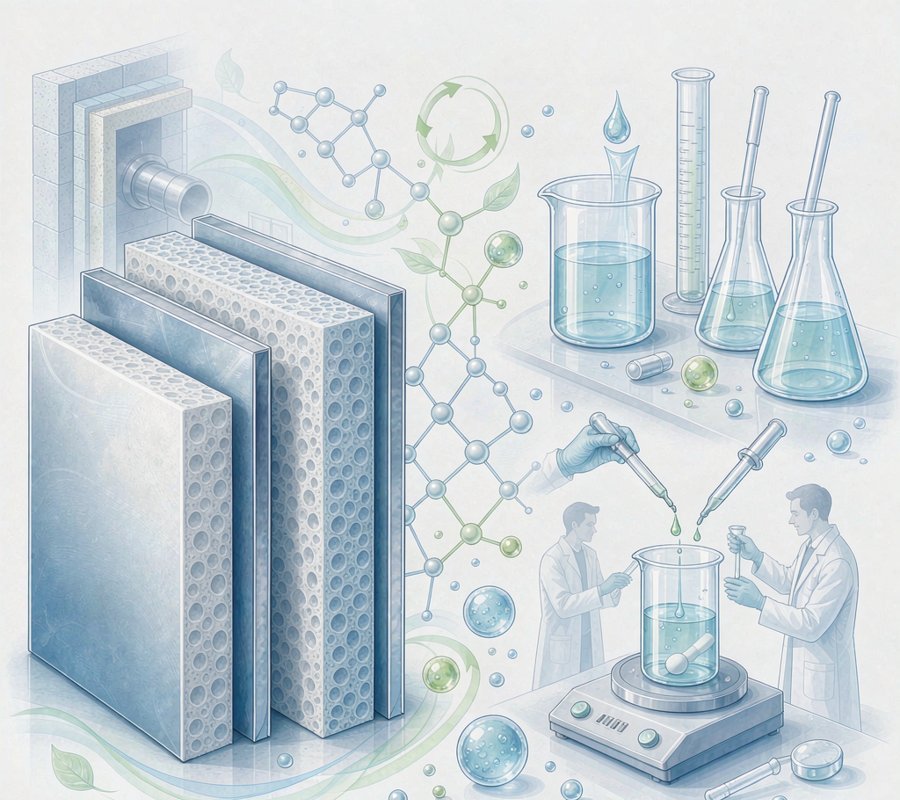
Matched HFO blowing packages are pulling stabiliser and catalyst suppliers into joint validation. (Original illustration)
3. HFO Stabilisers Move to Matched Packages as China Closes the HCFC-141b Door
1. Summary: A 2026–2033 market analysis of HFO foam stabilisers describes a structural shift from single-product selling to bundled surfactant-and-catalyst sets matched to HFO systems. Momentive’s rigid-foam guide pairs HFO-compatible silicones with catalysts promoted for shelf life with HFO-1233zd, and Arkema launched Foranext Continuum on 23 September 2026 for rigid foam made with Forane 1233zd, aimed at holding formulations stable over time in insulation, roofing and appliances. The report argues that value is moving to suppliers able to offer a tested package backed by ageing data, because foam makers can cut trial time and reduce foam-failure risk. Two pressures frame demand. First, the EU’s proposed PFAS restriction covers HFOs containing a CF3 group, leaving many European foam makers keeping hydrocarbon backup formulations ready and favouring stabilisers that work in both HFO and pentane systems. Second, China’s HCFC-141b phase-out took effect in polyol blends and polyurethane products on 1 January 2026 and in spray foam on 1 July 2026, with the 2026 production quota set to zero. North America is put at 42 percent of the 2026 market; Asia Pacific is the fastest-growing region at about 12.5 percent compound annual growth.
2. Source: Coherent Market Insights, “HFO Foam Stabilizers Market Size and Share Analysis, 2026–2033”, and company product announcements cited therein. Promotional listings and contacts excluded.
3. Editor’s Pick + Reason: The recommendation to qualify grades that run in both HFO and pentane systems. Reason: With EU PFAS rules unresolved and China’s 141b exit already in force, dual compatibility is a hedging specification that keeps a formulator usable under either regulatory outcome.
4. Low-Odour Dual-Action Catalysts and Cell-Control Chemistry Take the Foreground
1. Summary: Technical listings updated in mid-November point to a reformulation around low-odour, dual-function catalysts. Tetramethyl-1,3-propanediamine (TMPDA, CAS 110-95-2) is presented as a strong tertiary amine that catalyses both the isocyanate-water blowing reaction and the isocyanate-polyol gel reaction, with high efficiency and comparatively low odour for high-resilience slabstock, moulded foam and refrigerator or board rigid foam. BASF’s Lupragen BisDMAPU (CAS 52338-87-1), a low-emission urea catalyst for flexible foam, is listed by the industry association as part of the same move to emission-controlled amine design. Potassium oleate grades are described as balanced catalysts for polyisocyanurate reactions that can replace organotin and some tertiary or alkanolamine catalysts in rigid pour and spray systems, offering fast blow and gel with light colour and low odour. Formulation guidance on high-resilience foam puts high-molecular-weight polyether polyol at 60 to 70 percent, the isocyanate index at 1.05 to 1.10 and graft-modified polymer at 5 to 8 percent, with cell openers, silicone surfactants and nano-silica used to refine cells and strengthen cell walls.
2. Source: ChemicalBook technical data sheets updated 14–16 Nov 2026; China Polyurethane Industry Association Isocyanate Committee (isachina.org.cn); Baidu B2B Wiki high-resilience formulation note. Supplier quotations, telephone numbers and contacts removed.
3. Editor’s Pick + Reason: The blow/gel dual-action claim paired with low odour in TMPDA. Reason: Balancing blowing and gelation in one molecule reduces the number of catalysts a formulator must tune, and a low-odour profile removes a common obstacle to using high-efficiency tertiary amines in occupied-space applications.
Compiled 18 November 2026. Illustrations are original, AI-generated, free of third-party licensing claims and free of watermarks. Dates and times refer to GMT+8.