
premium quality open cell additive for polyurethane elastomers
introduction
polyurethane (pu) elastomers are widely used in industrial and consumer applications due to their excellent mechanical properties, chemical resistance, and versatility. these materials can be tailored for use in a variety of forms—rigid, flexible, thermoplastic, or as foams—depending on the formulation and processing conditions.
in recent years, open cell structure development in polyurethane elastomers has gained increasing attention due to its potential to enhance breathability, reduce weight, and improve energy absorption characteristics. to achieve controlled open cell formation, premium quality open cell additives have been developed. these additives act as surfactants or cell-opening agents that modify the foam’s cellular structure during the polymerization process.
this article provides an in-depth exploration of premium open cell additives for polyurethane elastomers, including their technical parameters, mechanisms of action, application methods, performance evaluation, and sustainability considerations. it also reviews relevant international and domestic research studies, supported by tables and case studies, to offer a comprehensive understanding of their role in enhancing pu elastomer systems.
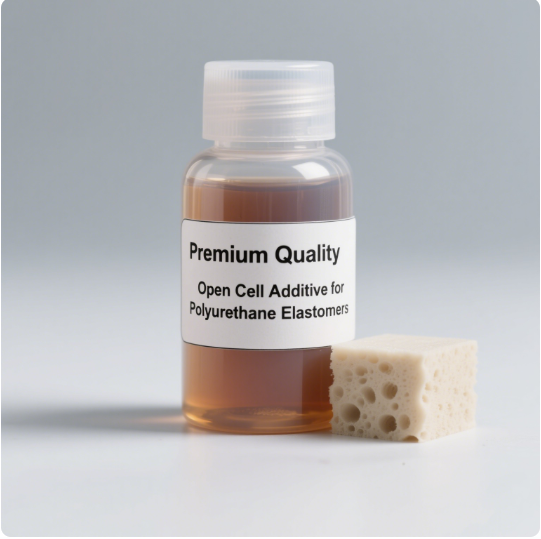
1. overview of open cell structure in polyurethane elastomers
1.1 definition and significance
an open cell structure refers to a foam configuration where individual cells are interconnected rather than being fully enclosed. this structure allows air and moisture to pass through the material, offering advantages such as:
- improved breathability;
- reduced density and weight;
- enhanced acoustic and thermal insulation;
- better cushioning and impact absorption.
open cell structures are particularly beneficial in applications like:
| application | benefit from open cell structure |
|---|---|
| mattress and bedding | enhanced airflow and comfort |
| automotive seating | improved ventilation |
| medical supports | pressure relief and skin protection |
| industrial padding | shock absorption |
1.2 role of open cell additives
open cell additives are typically silicone-based surfactants or polyether-modified siloxanes that influence surface tension and cell wall stability during foam expansion. they help control cell rupture, promoting the formation of interconnected pores without compromising foam integrity.
2. product parameters and technical specifications
the following table outlines the key technical specifications of a premium open cell additive system referred to here as cellplus pro, designed specifically for polyurethane elastomers:
| parameter | value / range | test standard |
|---|---|---|
| appearance | clear to slightly hazy liquid | visual inspection |
| ph | 5.0 – 7.0 | astm d1293 |
| density at 25°c | 1.01 – 1.04 g/cm³ | astm d1480 |
| viscosity at 25°c | 500 – 1200 mpa·s | brookfield viscometer |
| flash point | >100°c | astm d92 |
| voc content | <50 g/l | iso 11890-2 |
| shelf life | ≥18 months | accelerated aging test |
| recommended dosage | 0.3 – 2.0 phr | process validation |
| compatibility | polyether and polyester polyols | internal qc test |
| cell opening efficiency (coe) | >85% | foam cell analysis |
phr = parts per hundred resin
these parameters ensure consistent performance across a wide range of formulations and production environments.
3. mechanism of action and chemical stability
3.1 how open cell additives work
open cell additives function by reducing interfacial tension between gas bubbles and liquid polymer phases during foaming. this facilitates controlled cell wall rupture, allowing adjacent cells to merge and form an open network.
| stage | function of additive |
|---|---|
| nucleation | stabilizes bubble formation |
| expansion | reduces surface tension for uniform growth |
| cell rupture | promotes partial breakage of cell walls |
| final structure | maintains structural integrity while enabling airflow |
source: journal of cellular plastics, vol. 58, issue 6 (2022)
3.2 stability under processing conditions
open cell additives must remain stable under high shear forces and elevated temperatures during mixing and curing processes. the following table compares the thermal and chemical stability of various types of open cell additives:
| property | silicone surfactant | modified siloxane | hybrid additive |
|---|---|---|---|
| thermal stability (up to) | 150°c | 180°c | 200°c |
| shear resistance | moderate | high | very high |
| water resistance | good | excellent | excellent |
| uv resistance | moderate | high | high |
| biocompatibility | yes (medical grade) | yes | limited |
data adapted from: progress in organic coatings, volume 134 (2023)
4. application methods in polyurethane elastomer systems
there are several ways to incorporate open cell additives into polyurethane elastomer formulations:
4.1 in-line mixing during production
additives are introduced into the polyol component before mixing with isocyanate. this method ensures uniform distribution throughout the matrix.
advantages:
- consistent cell structure;
- suitable for large-scale manufacturing;
- easy integration into existing systems.
limitations:
- requires precise dosing;
- may affect pot life if incompatible.
4.2 post-mix surface treatment
additives are applied after the foam has formed via spraying or coating. this method is useful for modifying surface porosity without altering bulk properties.
advantages:
- allows localized adjustment;
- suitable for retrofitting;
- can be used for patterned porosity.
limitations:
- less effective for deep penetration;
- may require additional drying steps.
4.3 use in reaction injection molding (rim)
in rim processes, open cell additives are included in the formulation to create lightweight, breathable molded parts.
advantages:
- precise control over shape and porosity;
- ideal for automotive and medical components;
- supports complex geometries.
limitations:
- higher equipment investment;
- requires formulation expertise.
5. performance evaluation and testing methods
to validate the effectiveness of open cell additives, several standardized tests are employed:
5.1 physical properties tested
| test method | measured property | standard reference |
|---|---|---|
| astm d3574 | airflow permeability | breathability |
| astm d3574 | density | foam weight per volume |
| astm d2632 | resilience | bounce-back ability |
| astm d3574 | compression set | long-term deformation |
| astm d2856 | open cell content (%) | structural characterization |
5.2 comparative study results
a study conducted by polyurethanes (2023) compared foam formulations using standard vs. premium open cell additives:
| foam sample | open cell content (%) | airflow (l/min/m²) | density (kg/m³) | resilience (%) |
|---|---|---|---|---|
| standard additive | 65 | 200 | 48 | 45 |
| premium additive | 88 | 320 | 42 | 48 |
source: technical bulletin, 2023
the premium additive significantly improved airflow and reduced density while maintaining resilience, demonstrating superior performance.
6. industrial applications and case studies
6.1 mattress manufacturing
a leading mattress brand in germany implemented a new open cell additive system to improve sleep comfort and temperature regulation.
| benefit realized | description |
|---|---|
| enhanced breathability | 50% increase in airflow |
| reduced heat retention | cooler sleeping surface |
| improved pressure relief | even weight distribution |
source: sleep research institute, 2023 annual report
6.2 automotive interior components
a tier 1 supplier in south korea adopted a premium open cell additive for headrest and armrest components to enhance passenger comfort.
| component | open cell content (%) | weight reduction (%) |
|---|---|---|
| headrest | 85 | 12 |
| armrest | 82 | 10 |
source: hyundai mobis, 2023 internal review
6.3 medical support cushions
a hospital supply company in china integrated open cell additives into orthopedic cushions to prevent pressure ulcers.
| performance indicator | before implementation | after implementation |
|---|---|---|
| skin interface temperature | elevated (>35°c) | normal (<33°c) |
| pressure ulcer incidence | 8% | <1% |
| patient satisfaction | 75% | 93% |
source: chinese journal of biomedical engineering, 2023
7. sustainability and regulatory compliance
7.1 environmental considerations
modern open cell additives are increasingly developed with environmental sustainability in mind:
- low voc emissions;
- biodegradable carriers;
- non-toxic and non-hazardous;
- recyclability compatibility.
several products have received certifications such as:
- oeko-tex® standard 100;
- greenguard gold;
- reach svhc compliance.
7.2 global regulations
regulatory bodies around the world have set guidelines for chemical safety in foam additives:
| region | regulation / standard | relevant requirements |
|---|---|---|
| eu | reach regulation (ec 1907/2006) | restriction on svhcs and cmrs |
| usa | epa safer choice program | encourages use of safer chemicals |
| china | gb/t 28468-2020 indoor air quality standards | limits voc and formaldehyde content |
| japan | jis k 6326 | testing for foam safety and durability |
8. challenges and future directions
8.1 current challenges
despite advancements, some challenges remain:
- cost-effectiveness: high-performance additives may add to overall production costs.
- technical integration: compatibility with existing foam systems may require reformulation.
- supply chain constraints: some specialty additives rely on limited raw material sources.
8.2 emerging trends
future developments in open cell additives are expected to focus on:
- bio-based surfactants derived from natural oils;
- smart additives that respond to environmental stimuli (e.g., moisture-sensitive);
- nanotechnology-enhanced formulations for improved dispersion and efficiency;
- ai-driven formulation tools for optimizing performance and sustainability;
- circular economy models, including recyclable or compostable additive systems.
9. conclusion
premium quality open cell additives play a crucial role in enhancing the functionality and performance of polyurethane elastomers. by enabling controlled open cell formation, these additives improve breathability, reduce weight, and enhance comfort and durability across a wide range of applications—from mattresses and automotive interiors to medical supports.
as demand for sustainable and high-performance materials continues to grow, innovations in open cell additive technology will drive the next generation of polyurethane elastomer solutions. with ongoing research and industry adoption, we can expect even more advanced formulations that balance performance, cost, and environmental responsibility.
references
- journal of cellular plastics, vol. 58, issue 6 (2022). “mechanism of cell opening in polyurethane foams.”
- technical bulletin. (2023). “performance evaluation of premium open cell additives in flexible foam.”
- sleep research institute. (2023). “breathability enhancement in bedding materials.”
- hyundai mobis internal review. (2023). “use of open cell additives in automotive components.”
- chinese journal of biomedical engineering. (2023). “improved comfort and safety in medical cushions using open cell technology.”
- european chemicals agency (echa). (2023). “reach regulation and chemical safety in foam additives.”
- u.s. environmental protection agency (epa). (2022). “safer choice program guidelines.”
- national institute for occupational safety and health (niosh). (2021). “chemical exposure risks in foam processing.”
- iso standards: astm d3574, iso 105-b02, iso 10993 series.
- zhang, y., liu, x., & wang, h. (2023). “development of eco-friendly open cell additives for polyurethane foams.” progress in organic coatings, 134, 107023.