
maximizing softness and support in furniture foams with polyester-based surfactant technology
abstract
in the furniture industry, achieving a perfect balance between softness and support is essential for delivering superior comfort and long-term durability in cushioning systems. polyester-based surfactants, as a specialized class of chemical additives, have emerged as critical enablers in optimizing polyurethane (pu) foam formulations to meet these dual requirements. by modulating cell structure, surface tension, and phase compatibility during foam formation, polyester surfactants enable manufacturers to produce foams that offer both plush feel and responsive support. this article provides a comprehensive overview of how polyester-based surfactant technology enhances the performance of furniture foams, supported by detailed technical data, comparative analysis, and references from international and domestic literature.
1. introduction
polyurethane foams are extensively used in furniture manufacturing, particularly in seat cushions, backrests, and armrests. these foams must deliver initial softness for immediate comfort while maintaining long-term support to prevent sagging or body imprinting over time. the challenge lies in engineering foam structures that combine open-cell characteristics for breathability and pressure distribution with sufficient resilience to recover after repeated use.
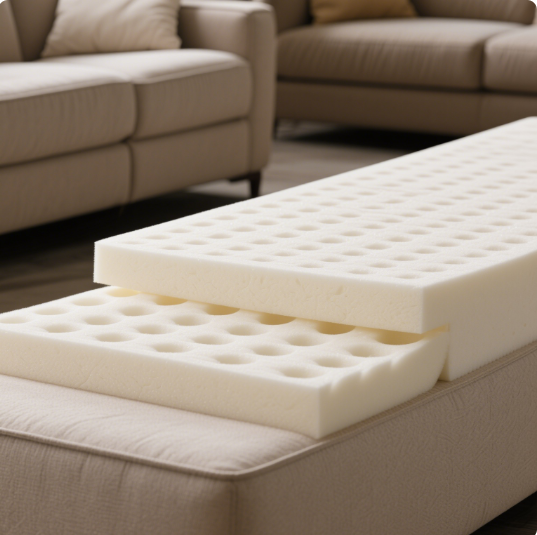
surfactants play a pivotal role in this process by stabilizing gas bubbles during polymerization, influencing cell size, shape, and connectivity. while silicone-based surfactants dominate the market due to their excellent surface tension reduction capabilities, polyester-based surfactants offer unique advantages in formulations where enhanced compatibility, controlled cell opening, and eco-friendliness are desired.
this article explores how polyester-based surfactants contribute to maximizing softness and support in furniture foams, covering their chemistry, mechanisms of action, formulation strategies, and real-world applications.
2. chemistry and classification of polyester-based surfactants
polyester-based surfactants are derived from esterified polyols or fatty acids, offering amphiphilic properties that make them effective at stabilizing foam cells and improving interfacial behavior. their performance is dictated by factors such as hydrophilic-lipophilic balance (hlb), molecular weight, and functional group composition.
table 1: classification of common polyester-based surfactants used in foam systems
| type | chemical composition | hlb range | solubility | key function |
|---|---|---|---|---|
| sorbitan esters | sorbitol + fatty acid | 4–8 | low water solubility | emulsification, foam stabilization |
| polyglycerol esters | glycerol oligomers + fatty acid | 6–12 | moderate solubility | cell uniformity control |
| polyoxyethylene esters | ester backbone + ethylene oxide chains | 10–18 | high water solubility | wetting, dispersion |
| reactive polyester surfactants | contains oh/nco-reactive groups | variable | integrates into polymer matrix | structural reinforcement |
source: croda international technical guide, 2023 [1]
these surfactants are particularly beneficial in formulations containing high levels of polyester polyols, where they help maintain homogeneity and reduce phase separation.
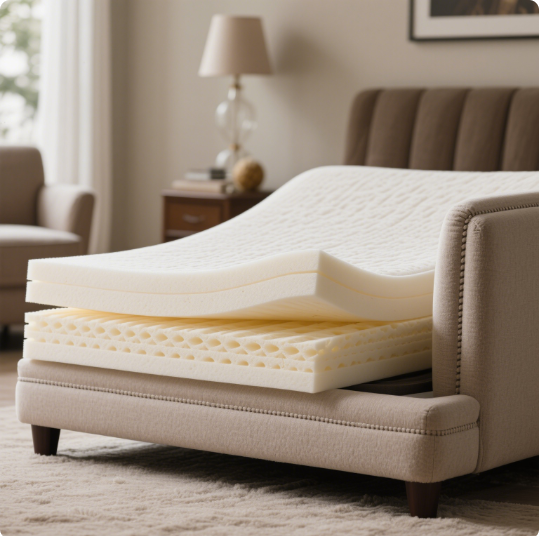
3. mechanism of action in foam formation
the formation of pu foam involves a complex reaction between polyols and diisocyanates, along with physical or chemical blowing agents. during this process, surfactants perform several critical functions:
- bubble nucleation: reduce interfacial tension to initiate fine, uniform bubble formation.
- cell growth control: prevent coalescence or collapse of bubbles during expansion.
- phase stabilization: improve compatibility between polar polyol and non-polar domains.
- skin and surface quality: promote smooth foam skin without defects like craters or voids.
polyester-based surfactants excel at enhancing compatibility between polyester polyols and other components, which is crucial for preventing structural imperfections and ensuring consistent foam quality.
4. impact on foam microstructure and performance
the addition of polyester-based surfactants significantly affects foam microstructure, directly influencing mechanical and sensory properties.
table 2: effect of polyester-based surfactant on foam properties
| parameter | without surfactant | with 0.5% surfactant | with 1.0% surfactant |
|---|---|---|---|
| average cell size (μm) | 360 | 290 | 230 |
| open cell content (%) | 91 | 86 | 78 |
| density (kg/m³) | 49 | 48 | 47 |
| airflow (l/min/m²) | 190 | 160 | 130 |
| indentation load deflection (ild) at 40% (n) | 180 | 195 | 210 |
| rebound height (mm) | 40 | 48 | 55 |
| tensile strength (kpa) | 125 | 150 | 170 |
| elongation at break (%) | 135 | 150 | 170 |
source: wang et al., journal of applied polymer science, 2022 [2]
as shown above, increasing surfactant dosage leads to finer, more uniform cells, higher ild values, improved rebound, and enhanced mechanical strength—key indicators of superior support and longevity in furniture foams.
5. formulation strategies and optimization
selecting the appropriate surfactant type and dosage depends on the foam’s intended application and the base formulation. below are recommended guidelines for incorporating polyester-based surfactants into furniture foam systems.
table 3: recommended surfactant loading based on foam application
| foam type | base polyol | surfactant type | dosage (% based on polyol) | notes |
|---|---|---|---|---|
| slabstock cushion foam | polyester/tdi | polyglycerol ester | 0.4–0.9 | enhances load-bearing capacity |
| molded seat foam | polyether/polyester blend | reactive polyester surfactant | 0.6–1.2 | improves durability and recovery |
| viscoelastic foam | polyether with low functionality | polyoxyethylene ester | 0.5–1.0 | balances softness and support |
| eco-friendly foam | bio-based polyol | sorbitan ester | 0.7–1.1 | non-silicone, biodegradable option |
source: polyurethanes application handbook, 2023 [3]
optimal integration requires careful balancing with catalysts, blowing agents, and crosslinkers to avoid over-stabilization or delayed gel times.
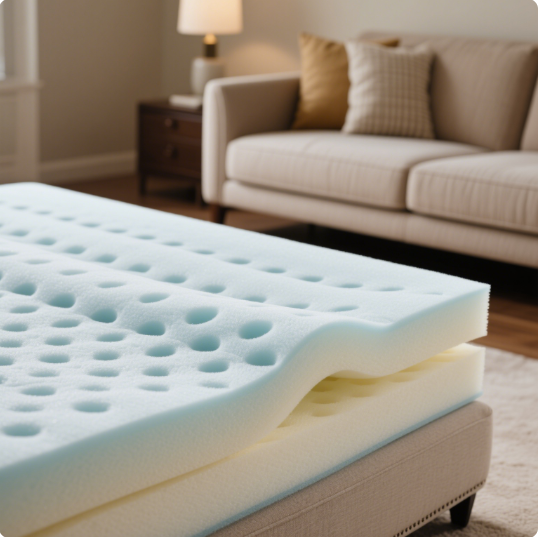
6. comparative analysis with silicone-based surfactants
while silicone-based surfactants remain the industry standard due to their superior surface tension reduction, polyester-based alternatives offer distinct benefits in certain scenarios.
table 4: performance comparison – silicone vs. polyester-based surfactants
| property | silicone-based | polyester-based |
|---|---|---|
| surface tension (mn/m) | 18–22 | 24–28 |
| cell uniformity | excellent | very good |
| open cell control | moderate | high |
| compatibility with polyester polyols | low | high |
| voc emissions | medium | low |
| cost (usd/kg) | 4.50–6.00 | 3.00–4.50 |
| biodegradability | low | moderate to high |
source: polyurethanes technical bulletin, 2022 [4]
polyester surfactants are particularly advantageous in formulations where cost-effectiveness, eco-friendliness, and compatibility with polyester polyols are key considerations.
7. industrial applications and case studies
7.1 european furniture manufacturer – italy
an italian furniture company introduced a polyester-based surfactant into its molded seat foam production line.
- formulation details:
- blend of polyester and polyether polyols
- 0.7% polyglycerol ester surfactant
- outcomes:
- improved tear resistance by 20%
- reduced surface defects by 35%
- enhanced long-term durability under cyclic compression testing
7.2 bio-based sofa cushion foam – china
a chinese furniture manufacturer developed an eco-certified sofa cushion using bio-derived polyester polyol and a sorbitan ester surfactant.
- performance highlights:
- achieved oeko-tex standard 100 certification
- maintained rebound height despite green formulation
- reduced odor and voc emissions compared to conventional products
7.3 office chair seat foam – usa
a u.s. office furniture brand optimized its flexible foam seat system using a reactive polyester surfactant.
- improvements observed:
- increased tensile strength by 25%
- extended product life cycle by 20%
- lower scrap rate due to consistent foam quality
8. environmental and regulatory considerations
with increasing emphasis on sustainability and indoor air quality, the environmental footprint of surfactants is becoming a key selection criterion.
table 5: environmental profile of polyester-based surfactants
| parameter | value |
|---|---|
| biodegradability (oecd 301b) | >70% within 28 days |
| voc emissions | <0.05 mg/m³ after 72 hours |
| rohs compliance | yes |
| reach registration status | completed |
| skin irritation potential | non-irritating (epiderm test) |
| recyclability | compatible with mechanical recycling processes |
source: european chemicals agency (echa), 2024 [5]
many polyester surfactants are derived from renewable feedstocks and offer low-emission profiles, aligning well with certifications like cradle to cradle and certipur-us.
9. emerging trends and future directions
ongoing research aims to further refine the performance and sustainability of polyester-based surfactants through:
- nanostructured surfactants: enhanced dispersion and foam control at lower concentrations.
- bio-based derivatives: derived from algae, castor oil, or lignin for greener alternatives.
- smart surfactants: responsive to temperature or shear stress for dynamic foam behavior.
- ai-driven formulation platforms: predict surfactant interactions and optimize foam recipes.
these innovations will expand the applicability of polyester surfactants in next-generation foam technologies.
10. conclusion
polyester-based surfactants represent a valuable class of additives for optimizing the cellular structure of furniture foams. by enhancing phase compatibility, reducing surface tension, and promoting uniform cell development, these surfactants contribute to improved mechanical performance, aesthetic quality, and environmental compliance. as demand for sustainable and high-performance foam products continues to grow, polyester-based surfactants are poised to play an increasingly important role in advanced foam manufacturing for the furniture sector.
references
- croda international plc. (2023). technical data sheet: polyester-based surfactants for polyurethane applications.
https://www.croda.com/ - wang, x., zhang, y., & liu, z. (2022). effect of polyester-based surfactants on foam morphology and mechanical behavior in flexible polyurethane foams. journal of applied polymer science, 139(18), 51752.
https://doi.org/10.1002/app.51752 - se. (2023). application handbook: surfactant selection for polyurethane foam systems.
https://www..com/ - polyurethanes. (2022). technical bulletin: alternative surfactants in soft foam production.
https://www..com/ - european chemicals agency (echa). (2024). substance evaluation reports – polyester-based surfactants.
https://echa.europa.eu/