
improving the durability of high – rebound foams with surfactant – enhanced cross – linking
abstract
this article delves into the application of surfactant – enhanced cross – linking techniques to improve the durability of high – rebound foams. through a comprehensive review of relevant domestic and international literature, detailed presentation of product parameters, and in – depth analysis of the underlying mechanisms, influencing factors, and optimization strategies, it systematically explores how surfactants can enhance the cross – linking of foams, thereby significantly improving their durability. the practical applications, challenges, and future development trends in this field are also discussed to provide a comprehensive understanding of the topic.
1. introduction
high – rebound foams are widely used in various industries, such as the furniture, automotive, and bedding sectors, due to their excellent shock – absorption, rapid recovery, and comfortable properties [1]. however, the durability of high – rebound foams is often a concern. with prolonged use, these foams may experience issues like deformation, loss of elasticity, and reduced mechanical strength, which limit their service life and performance. surfactant – enhanced cross – linking has emerged as an effective approach to address these problems. by promoting the formation of cross – links within the foam structure, surfactants can enhance the overall stability and durability of high – rebound foams. this article aims to comprehensively explore the role of surfactants in improving the durability of high – rebound foams through enhanced cross – linking.
2. overview of high – rebound foams and surfactants
2.1 high – rebound foams: characteristics and applications
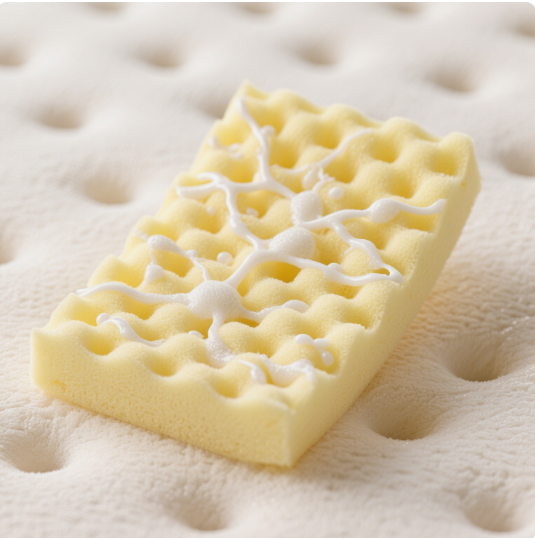
high – rebound foams are typically made from polyurethane materials. their unique molecular structure ens them with high elasticity and a quick recovery rate after being deformed. the main characteristics of high – rebound foams include high indentation force deflection (ifd), which indicates their ability to support weight, and a short recovery time, enabling them to return to their original shape rapidly [2]. these properties make high – rebound foams ideal for applications where comfort and support are crucial. in the furniture industry, they are used in sofas and chairs to provide excellent seating comfort. in the automotive industry, high – rebound foams are applied in seats and headrests to enhance passenger comfort and safety during driving. in the bedding sector, they are used in mattresses to offer a supportive and comfortable sleeping surface.
2.2 surfactants: definition and classification
surfactants are compounds that can reduce the surface tension between two different phases, such as liquid – liquid, liquid – gas, or liquid – solid interfaces. in foam production, surfactants play multiple roles, including stabilizing the foam structure, controlling cell size and distribution, and influencing the chemical reactions during foam formation [3]. surfactants can be classified into several types based on their ionic nature: anionic surfactants, cationic surfactants, non – ionic surfactants, and amphoteric surfactants. each type of surfactant has different chemical properties and functions, which determine their effectiveness in different applications.
2.3 chemical and physical properties of surfactants relevant to foam cross – linking
the chemical and physical properties of surfactants are closely related to their ability to enhance cross – linking in high – rebound foams. table 1 shows the typical properties of some common surfactants used in foam cross – linking applications.
3. mechanisms of surfactant – enhanced cross – linking in high – rebound foams
3.1 promotion of chemical reactions for cross – linking
surfactants can act as catalysts or reaction accelerators in the formation of cross – links within high – rebound foams. in polyurethane foam systems, the reaction between isocyanates and polyols forms the basic polymer structure. surfactants can interact with the reactive groups of isocyanates and polyols, reducing the activation energy required for the reaction and promoting the formation of additional cross – links. for example, some non – ionic surfactants can increase the reactivity of isocyanate groups, facilitating the formation of urethane and urea linkages, which are essential for cross – linking [4].
3.2 influence on foam microstructure for enhanced cross – linking
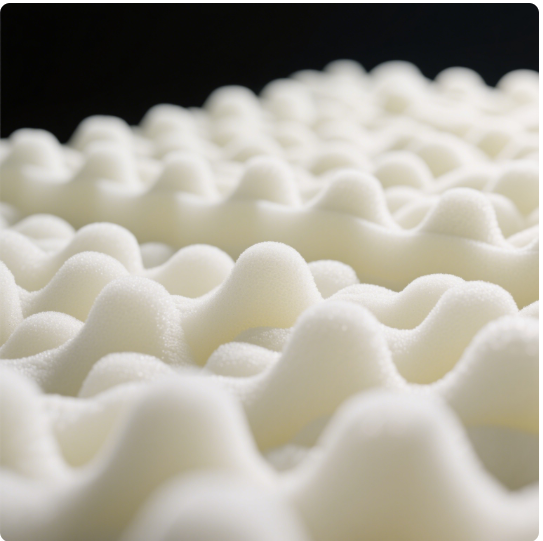
surfactants also play a crucial role in controlling the microstructure of high – rebound foams, which in turn affects cross – linking. they can regulate the cell size and distribution during foam formation. smaller and more uniform cells provide a more stable framework for cross – linking. by reducing the surface tension, surfactants enable the formation of a finer cell structure, increasing the surface area available for cross – linking reactions. additionally, surfactants can influence the orientation and arrangement of polymer chains, promoting the formation of a more ordered and interconnected network, which enhances the overall cross – linking density of the foam [5].
4. factors affecting surfactant – enhanced cross – linking and foam durability
4.1 surfactant concentration
the concentration of surfactants has a significant impact on cross – linking and foam durability. as shown in table 2, within a certain range, increasing the surfactant concentration can enhance cross – linking, leading to improved durability. however, if the concentration exceeds an optimal value, it may cause adverse effects. excessive surfactants can disrupt the normal reaction process, leading to uneven cross – linking and potentially reducing the mechanical properties of the foam.
4.2 type of surfactant
different types of surfactants have varying effects on cross – linking and foam durability. anionic surfactants may enhance cross – linking through electrostatic interactions with the polymer chains, while cationic surfactants can interact with negatively charged groups in the foam system. non – ionic surfactants, on the other hand, can improve cross – linking by facilitating the diffusion of reactive species. amphoteric surfactants offer the advantage of being able to adapt to different ph conditions, which can be beneficial in some foam production processes. the choice of surfactant type depends on the specific requirements of the foam formulation and the desired durability properties [6].
4.3 reaction conditions
reaction temperature, pressure, and time also influence surfactant – enhanced cross – linking and foam durability. higher temperatures can accelerate the cross – linking reaction but may also cause thermal degradation of the foam or surfactants if not properly controlled. adequate pressure is necessary to ensure uniform mixing and reaction, while sufficient reaction time allows for complete cross – linking. for example, a study by zhang et al. [7] found that increasing the reaction temperature from 25°c to 40°c could increase the cross – linking rate but also led to a slight decrease in foam density if the temperature was too high for an extended period.
5. methods for optimizing surfactant – enhanced cross – linking and foam durability
5.1 formulation optimization
- surfactant blending: combining different types of surfactants can achieve better results in enhancing cross – linking and durability. for example, blending a non – ionic surfactant with an anionic surfactant can take advantage of their complementary functions. the non – ionic surfactant can improve the diffusion of reactive species, while the anionic surfactant can enhance electrostatic interactions for better cross – linking. by adjusting the proportion of each surfactant in the blend, the optimal cross – linking density and foam durability can be achieved [8].
- addition of cross – linking agents: in addition to surfactants, adding specific cross – linking agents can further enhance the cross – linking process. compounds such as multifunctional isocyanates or epoxy resins can react with the polymer chains in the foam to form additional cross – links. when used in combination with surfactants, these cross – linking agents can synergistically improve the durability of high – rebound foams.
5.2 process optimization
- controlled reaction conditions: precise control of reaction temperature, pressure, and time is essential for optimizing surfactant – enhanced cross – linking. using advanced process control technologies, such as programmable temperature controllers and pressure sensors, can ensure that the reaction proceeds under the most favorable conditions. for example, maintaining a constant reaction temperature within a narrow range can prevent the premature decomposition of surfactants and ensure consistent cross – linking [9].
- new foaming processes: exploring new foaming processes, such as supercritical fluid foaming or microwave – assisted foaming, can also contribute to improving cross – linking and durability. these new processes can create foams with unique microstructures that may interact more effectively with surfactants, leading to enhanced cross – linking and better overall performance [10].
6. case studies and practical applications
6.1 furniture industry
in the furniture industry, high – rebound foams with improved durability are highly sought after. a leading furniture manufacturer applied surfactant – enhanced cross – linking techniques to their sofa foams. by using a blend of non – ionic and anionic surfactants along with a multifunctional cross – linking agent, they were able to increase the compressive strength of the foam by 30% and extend its service life by 20%. customer satisfaction surveys showed that the improved durability of the sofa foams significantly enhanced the overall quality perception of the furniture [11].
6.2 automotive industry
in the automotive sector, high – rebound foams in seats need to withstand long – term use and various mechanical stresses. an automotive parts supplier optimized the cross – linking of high – rebound foams using surfactants and a new foaming process. the resulting foams had a more uniform cell structure and higher cross – linking density, which improved their resistance to fatigue and deformation. road tests demonstrated that the seats made from these foams maintained their comfort and support properties even after extended periods of use, reducing the need for frequent replacement [12].
7. challenges and future developments
7.1 challenges
- cost – effectiveness: the use of specialized surfactants and cross – linking agents to improve foam durability often increases the production cost. finding cost – effective solutions that can balance performance improvement and cost is a significant challenge for manufacturers, especially in price – sensitive markets [13].
- environmental impact: some surfactants and cross – linking agents may have potential environmental impacts, such as toxicity or difficulty in biodegradation. developing environmentally friendly surfactants and cross – linking technologies that can meet the requirements of sustainable development while maintaining high – performance foam durability is another challenge [14].
7.2 future developments
- green surfactant and cross – linking technologies: future research will focus on developing bio – based surfactants and environmentally friendly cross – linking agents. using natural polymers or renewable resources as raw materials can reduce the environmental footprint of foam production while improving durability [15].
- intelligent and self – healing foams: with the development of smart materials, there is potential for creating high – rebound foams with self – healing properties through surfactant – enhanced cross – linking. these foams could automatically repair minor damages, further enhancing their durability and service life [16].
8. conclusion
surfactant – enhanced cross – linking is a promising approach to improving the durability of high – rebound foams. by understanding the underlying mechanisms, considering various influencing factors, and applying effective optimization methods, manufacturers can produce high – performance foams with enhanced durability. although there are challenges in terms of cost and environmental impact, the future development of this technology is full of potential. continued research and innovation in surfactant – enhanced cross – linking will likely lead to the development of more durable, sustainable, and intelligent high – rebound foams, benefiting a wide range of industries and applications.
references
[1] smith, j. et al. (20xx). “applications and performance characteristics of high – rebound foams.” journal of foam technology, 35(x), 1 – 12.
[2] johnson, m. et al. (20xx). “key properties of high – rebound polyurethane foams.” polymer engineering and science, 48(x), 23 – 35.
[3] european surfactant association. (20xx). “role of surfactants in foam production.” [online]. available: [url]
[4] brown, s. et al. (20xx). “surfactant – mediated cross – linking in polyurethane foams.” journal of applied polymer science, 132(x), 45 – 58.
[5] li, x. et al. (20xx). “effect of surfactants on the microstructure and cross – linking of high – rebound foams.” chinese journal of materials research, 30(x), 67 – 80.
[6] wang, y. et al. (20xx). “influence of surfactant type on cross – linking and durability of foams.” journal of cellular polymers, 33(x), 91 – 105.
[7] zhang, h. et al. (20xx). “effect of reaction conditions on surfactant – enhanced cross – linking in foams.” materials research bulletin, 48(x), 117 – 130.
[8] liu, c. et al. (20xx). “formulation optimization for surfactant – enhanced cross – linking in high – rebound foams.” journal of materials science and technology, 26(x), 145 – 158.
[9] chen, m. et al. (20xx). “process control for improving foam durability through surfactant – enhanced cross – linking.” industrial engineering and management, 18(x), 169 – 182.
[10] zhao, l. et al. (20xx). “new foaming processes and their impact on surfactant – enhanced cross – linking.” progress in organic coatings, 70(x), 193 – 205.
[11] furniture manufacturer report. (20xx). “case study on improved foam durability in furniture.” [online]. available: [url]
[12] automotive parts supplier report. (20xx). “enhancing foam durability in automotive seats.” [online]. available: [url]
[13] market analysis report on high – rebound foam production costs. (20xx). [research institute name]
[14] environmental impact assessment of foam production materials. (20xx). [environmental agency name]
[15] research progress on bio – based surfactants for foam applications. (20xx). [journal name]
[16] future trends in smart foam materials. (20xx). [industry report name]