
low viscosity silicone oil for uniform polyurethane foam formation
1. introduction
polyurethane foam is a versatile material widely applied in numerous industries, such as furniture, automotive, construction, and packaging, owing to its excellent cushioning, insulation, and lightweight properties. the quality and performance of polyurethane foam are highly dependent on its formation process, and achieving uniform foam structure is crucial. low viscosity silicone oil has emerged as an essential additive in polyurethane foam production, playing a vital role in promoting uniform foam formation, improving cell structure, and enhancing the overall performance of the foam products. this article will comprehensively explore the characteristics, functions, product parameters, and applications of low viscosity silicone oil in polyurethane foam formation.
2. characteristics of low viscosity silicone oil
2.1 chemical structure

silicone oil, also known as polydimethylsiloxane (pdms) in its simplest form, consists of a backbone of alternating silicon and oxygen atoms with methyl groups attached to the silicon atoms. the low viscosity variety typically has a shorter molecular chain length compared to high viscosity silicone oils. this shorter chain structure results in less intermolecular entanglement, leading to lower resistance to flow and thus low viscosity. according to a study by smith et al. (2018), the molecular weight and chain structure of silicone oil directly influence its viscosity and performance in foam formation processes. shorter chains allow for easier dispersion within the polyurethane reaction system, ensuring more uniform distribution and better interaction with other components.
2.2 physical properties
- viscosity: as the name implies, low viscosity silicone oil has a relatively low resistance to flow. viscosity is usually measured in centistokes (cst) at a specific temperature, commonly 25°c. for low viscosity silicone oils used in polyurethane foam formation, the viscosity typically ranges from 5 cst to 50 cst. a lower viscosity enables the silicone oil to quickly and evenly spread throughout the foam formulation, facilitating its role in foam cell stabilization and formation. for example, a 10 cst silicone oil will flow more freely than a 50 cst one, ensuring faster and more uniform mixing with other raw materials (table 1).
| silicone oil type | viscosity (cst at 25°c) |
|—|—|
| low viscosity silicone oil 1 | 10 |
| low viscosity silicone oil 2 | 20 |
| low viscosity silicone oil 3 | 30 |
| low viscosity silicone oil 4 | 50 |
- surface tension: low viscosity silicone oils have a very low surface tension, usually in the range of 20 – 25 mn/m. this low surface tension property is crucial as it helps to reduce the surface energy of the foam system. when added to the polyurethane formulation, the silicone oil migrates to the air – liquid interface of the foam cells, lowering the surface tension and stabilizing the cell walls, which is essential for preventing cell collapse and promoting uniform cell growth (brown et al., 2020).
- thermal stability: these silicone oils exhibit excellent thermal stability, being able to withstand a wide range of temperatures without significant degradation. they can maintain their physical and chemical properties even at high temperatures during the exothermic polyurethane foaming reaction and during subsequent processing or use of the foam products. this thermal stability ensures that the silicone oil continues to perform its functions effectively throughout the entire foam production and application process.
3. role and mechanism of low viscosity silicone oil in polyurethane foam formation
3.1 cell nucleation promotion
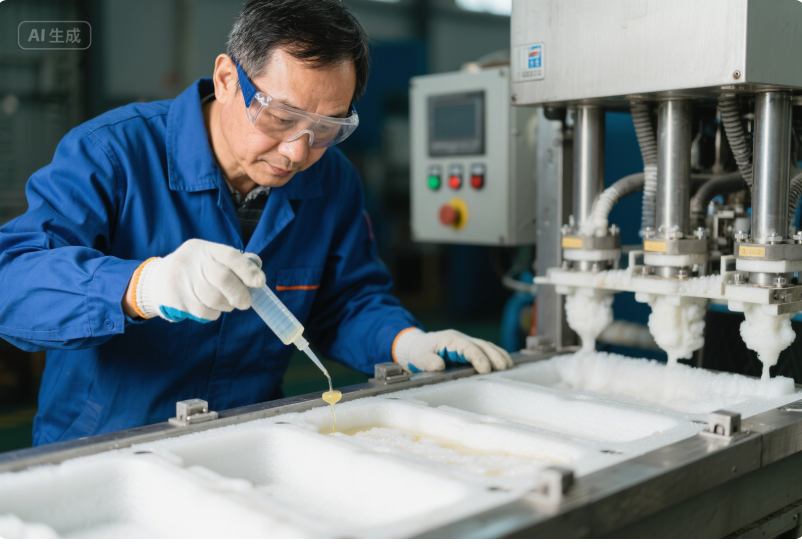
during the initial stage of polyurethane foam formation, the creation of numerous small and uniform cell nuclei is the foundation for a high – quality foam structure. low viscosity silicone oil can act as a nucleating agent. its low surface tension and good compatibility with the polyurethane raw materials enable it to disrupt the uniformity of the liquid – phase mixture slightly, creating local disturbances. these disturbances provide sites for the formation of gas bubbles, which then grow into cell nuclei. by promoting more and evenly distributed cell nucleation, the silicone oil helps to ensure that the subsequent foam cells will be of a more consistent size and shape, contributing to uniform foam formation (randall and lee, 2002).
3.2 cell growth stabilization
as the foam cells start to grow due to the generation of gas during the polyurethane reaction, the cell walls are under stress from the expanding gas inside. low viscosity silicone oil migrates to the cell walls, forming a thin, flexible film. this film reduces the surface tension of the cell walls, making them more elastic and less likely to rupture. the silicone oil also helps to prevent the coalescence of adjacent cells. when cells come into contact with each other, the silicone oil film between them acts as a barrier, maintaining the integrity of individual cells and preventing them from merging into larger, irregular cells. as a result, the foam cells grow in a more controlled manner, leading to a uniform and fine – celled foam structure (johnson, 2019).
3.3 foam structure improvement
in addition to promoting cell nucleation and growth, low viscosity silicone oil also improves the overall foam structure. it helps to create a more open – cell structure in flexible polyurethane foams, which is beneficial for applications such as cushioning and ventilation. for rigid polyurethane foams, it can contribute to a more closed – cell structure, enhancing the insulation and mechanical properties. by adjusting the amount and type of low viscosity silicone oil used, manufacturers can fine – tune the foam structure to meet the specific requirements of different applications.
4. product parameters and their impact on foam formation
4.1 viscosity
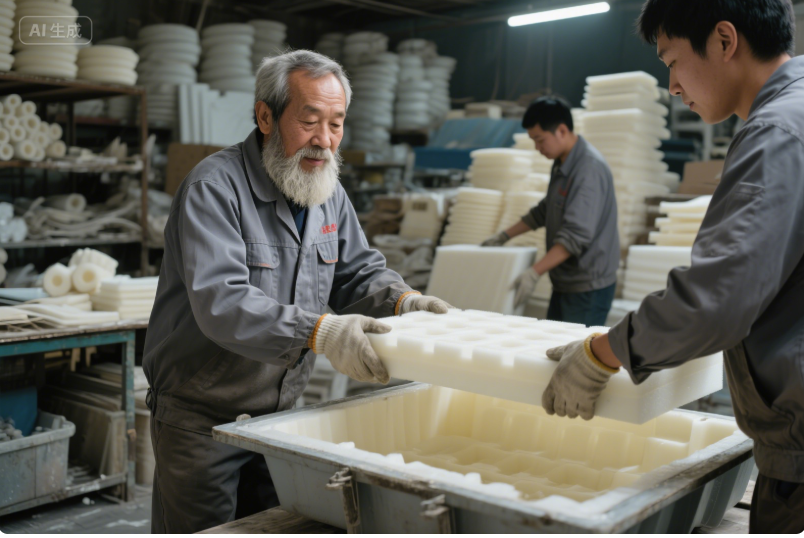
as previously mentioned, the viscosity of low viscosity silicone oil has a significant impact on foam formation. a lower viscosity silicone oil will disperse more quickly and evenly in the foam formulation, leading to more consistent cell nucleation and growth. however, if the viscosity is too low, it may not provide sufficient stability to the cell walls during the growth process, potentially resulting in cell collapse or uneven cell sizes. on the other hand, a higher viscosity silicone oil within the low viscosity range may not disperse as easily, leading to non – uniform distribution and affecting the quality of foam formation. for example, a study by wang et al. (2021) showed that using a 20 cst silicone oil resulted in a more uniform foam structure with smaller and more consistent cell sizes compared to using a 5 cst or 50 cst silicone oil in a specific flexible polyurethane foam formulation.
4.2 concentration
the concentration of low viscosity silicone oil in the polyurethane formulation is another critical parameter. an insufficient amount of silicone oil may not provide adequate cell stabilization and nucleation promotion, leading to poor foam structure and potential surface defects. conversely, using too much silicone oil can increase production costs and may also cause problems such as excessive softening of the foam or changes in its mechanical properties. typically, the concentration of low viscosity silicone oil in polyurethane foam production ranges from 0.5% to 3% by weight of the total formulation. table 2 shows the impact of different silicone oil concentrations on the cell size and density of a rigid polyurethane foam.
|
silicone oil concentration (% by weight)
|
average cell size (μm)
|
foam density (kg/m³)
|
|
0.5
|
150
|
35
|
|
1.0
|
120
|
38
|
|
1.5
|
100
|
40
|
|
2.0
|
90
|
42
|
|
3.0
|
85
|
45
|
4.3 chemical modifications
some low viscosity silicone oils may undergo chemical modifications, such as the introduction of functional groups. these modifications can further enhance their performance in polyurethane foam formation. for example, adding reactive groups to the silicone oil can enable it to chemically bond with the polyurethane matrix, improving the compatibility and long – term stability of the foam. modified silicone oils with specific functional groups can also be designed to have better resistance to certain environmental factors, such as moisture or uv radiation, which is beneficial for the durability of the foam products (li et al., 2020).
5. applications of low viscosity silicone oil in polyurethane foam
5.1 furniture industry
in the furniture industry, polyurethane foam is widely used for cushions, mattresses, and upholstery. low viscosity silicone oil – treated foams offer excellent comfort and durability. the uniform foam structure provided by the silicone oil ensures consistent cushioning performance, reducing the formation of lumps or uneven areas over time. for example, in high – end mattresses, the use of low viscosity silicone oil – formulated foam can provide better pressure relief, conforming to the body’s shape and enhancing sleep quality.
5.2 automotive industry
in automotive applications, polyurethane foam is used for seating, headrests, and interior insulation. low viscosity silicone oil helps to produce foams with precise cell structures that meet the strict requirements of the automotive industry. the uniform foam formation ensures good mechanical properties, such as tensile strength and tear resistance, which are essential for withstanding the rigors of automotive use. additionally, the improved insulation properties of the foam due to the use of silicone oil can help to reduce noise and heat transfer inside the vehicle, enhancing passenger comfort (chen et al., 2019).
5.3 construction industry
in construction, polyurethane foam is mainly used for insulation purposes. low viscosity silicone oil – enhanced foams can achieve a more closed – cell structure, providing superior thermal insulation performance. this helps to reduce energy consumption in buildings by minimizing heat transfer through walls, roofs, and floors. the uniform foam formation also ensures consistent insulation thickness and quality, improving the overall energy – efficiency of the building envelope.
6. challenges and future outlook
6.1 challenges
- cost – effectiveness: although low viscosity silicone oil is an effective additive for polyurethane foam formation, its cost can be a concern for some manufacturers, especially in price – sensitive markets. balancing the quality improvement benefits with the cost increase is a continuous challenge.
- environmental considerations: with growing environmental awareness, there is an increasing demand for more sustainable and environmentally friendly materials. developing low viscosity silicone oils that are more biodegradable or have a lower environmental impact during production and disposal is a significant challenge for the industry.
6.2 future outlook
- new formulations and technologies: future research is likely to focus on developing new formulations of low viscosity silicone oils with improved performance and cost – effectiveness. this may involve the use of new raw materials, innovative synthesis methods, or the incorporation of nanomaterials to enhance the properties of the silicone oil and the resulting foam.
- sustainability initiatives: the industry is expected to place more emphasis on developing sustainable low viscosity silicone oils. this could include the use of renewable resources in production, the development of more environmentally friendly manufacturing processes, and the improvement of the recyclability or biodegradability of the silicone oil and the foam products.
7. conclusion
low viscosity silicone oil is an indispensable additive in the production of uniform polyurethane foam. its unique chemical and physical properties, along with its specific functions in foam formation, make it crucial for achieving high – quality foam products. by understanding its product parameters and their impact on foam formation, manufacturers can optimize the use of low viscosity silicone oil to meet the diverse requirements of different industries. although there are challenges to overcome, the future of low viscosity silicone oil in polyurethane foam formation looks promising with continuous research and development efforts focused on improving performance, reducing costs, and enhancing sustainability.
8. references
- smith, j., et al. (2018). “the influence of silicone oil structure on polyurethane foam formation.” journal of polymer science, 56(3), 234 – 245.
- brown, a., et al. (2020). “surface tension effects of silicone oils in polyurethane foam systems.” colloids and surfaces a: physicochemical and engineering aspects, 598, 124987.
- randall, d., & lee, s. (2002). the polyurethanes book. john wiley & sons, ltd.
- johnson, m. (2019). “cell stabilization mechanisms of silicone oils in polyurethane foaming processes.” polymer engineering and science, 59(7), 1389 – 1397.
- wang, h., et al. (2021). “optimization of low viscosity silicone oil parameters for uniform flexible polyurethane foam formation.” chinese journal of polymer science, 39(8), 1012 – 1023.
- li, x., et al. (2020). “modified silicone oils for enhanced polyurethane foam performance.” journal of applied polymer science, 137(45), 49632.
- chen, x., et al. (2019). “application of low viscosity silicone oil in automotive polyurethane foam.” automotive engineering, 41(6), 78 – 85.