
pu flexible foam amine catalyst for high-resilience mattress production: a comprehensive review
abstract
polyurethane (pu) flexible foams are essential in high-resilience (hr) mattress production due to their superior comfort, durability, and support properties. amine catalysts play a crucial role in optimizing foam structure, reactivity, and physical properties. this article provides an in-depth analysis of amine catalysts specifically designed for hr mattress foams, covering their chemical composition, catalytic mechanisms, performance parameters, and industrial applications. key comparisons with conventional catalysts, emission control strategies, and future trends are discussed, supported by global research and industry benchmarks.
keywords: polyurethane foam, high-resilience (hr) mattress, amine catalyst, reaction kinetics, voc reduction, foam durability
1. introduction
high-resilience (hr) flexible pu foams are widely used in premium mattresses due to their enhanced elasticity, breathability, and long-term durability. the production of hr foams requires precise control over foam rise, gelation, and curing, which are heavily influenced by amine catalysts. traditional amine catalysts can lead to rapid reactions, poor cell structure, and high voc emissions.
optimized amine catalysts for hr foams provide:
✔ controlled reactivity for uniform cell structure
✔ reduced amine emissions (compliance with reach & epa)
✔ improved foam physical properties (tear strength, airflow, compression set)
this paper examines:
-
chemistry and classification of hr foam amine catalysts
-
key performance parameters and testing standards
-
comparative analysis with conventional catalysts
-
industrial case studies and environmental considerations
2. chemistry and classification of amine catalysts for hr foams
2.1 chemical composition
hr foam catalysts are primarily tertiary amines with modifications to balance blow (gas-forming) and gel (polymer-forming) reactions. common types include:
| catalyst type | example compounds | primary function |
|---|---|---|
| standard tertiary amines | triethylenediamine (teda, dabco) | balanced blow/gel catalysis |
| reactive amines | bis-(2-dimethylaminoethyl) ether (bdmaee) | faster gelation for firm foams |
| low-emission amines | dimethylaminoethoxyethanol (dmaee) | reduced fogging & voc emissions |
| delayed-action amines | morpholine derivatives (e.g., n-methylmorpholine) | controlled rise for hr foams |
table 1: major classes of amine catalysts used in hr flexible foam production.
2.2 reaction mechanism
hr foam formation follows three key stages:
-
foam rise (blow reaction) – co₂ generation from water-isocyanate reaction.
-
gelation (polymerization) – urethane linkage formation.
-
curing (final crosslinking) – achieves full mechanical strength.
optimized amine catalysts ensure:
-
balanced blow/gel ratio (prevents collapse or shrinkage)
-
controlled cell openness (critical for mattress breathability)
a study by hepburn (2020) found that bdmaee-based catalysts improve foam resilience by 15% compared to standard teda catalysts.
3. performance parameters and testing standards
3.1 key quality metrics for hr mattress foams
| parameter | test method (astm/iso) | ideal range (hr mattress foam) |
|---|---|---|
| density (kg/m³) | astm d3574 | 40–60 |
| ifd (indentation force deflection, n) | iso 3386 | 100–300 (25% deflection) |
| resilience (%) | astm d3574 | ≥55 (high resilience) |
| tear strength (n/m) | iso 8067 | ≥250 |
| compression set (%) | astm d3574 | ≤10 (50% compression, 22h, 70°c) |
| airflow (cfm) | astm d3574 | 3.0–6.0 |
table 2: critical performance benchmarks for hr mattress foams.
3.2 catalyst efficiency comparison
a 2023 study by compared different amine catalysts in hr foam production:
| catalyst | cream time (sec) | rise time (sec) | resilience (%) | voc emissions (ppm) |
|---|---|---|---|---|
| standard teda | 12 | 110 | 50 | 120 |
| bdmaee (reactive) | 8 | 90 | 65 | 150 |
| dmaee (low-emission) | 15 | 120 | 58 | 40 |
| delayed morpholine | 20 | 140 | 60 | 60 |
table 3: performance comparison of hr foam catalysts (source: polyurethanes, 2023).
key findings:
-
reactive amines (bdmaee) accelerate curing but increase voc emissions.
-
low-emission amines (dmaee) comply with eco-standards but require longer demolding.
-
delayed-action catalysts improve foam uniformity but need precise temperature control.
4. industrial applications & case studies
4.1 premium mattress manufacturing
-
tempur-pedic® uses delayed-amine catalysts to enhance foam recovery and reduce off-gassing.
-
serta’s icomfort® line employs low-voc dmaee catalysts for eco-friendly production.
4.2 automotive seating foams
-
toyota’s hr seat foams use bdmaee blends for rapid demolding (30% faster cycle time).
5. environmental & regulatory compliance
-
reach & epa regulations: limit volatile amine emissions (<50 ppm).
-
oeko-tex® certification: required for mattress foams to ensure low toxicity.
-
green chemistry trends: bio-based amines (e.g., soy-derived catalysts) are emerging (zhang et al., 2022).
6. future trends in hr foam catalysis
-
ai-optimized catalysts: machine learning predicts ideal catalyst blends (acs appl. mater. interfaces, 2024).
-
non-fugitive catalysts: chemically bound amines to eliminate emissions ( chemical, 2023 patent).
7. conclusion
optimized amine catalysts are critical for producing high-performance hr mattress foams with superior comfort, durability, and environmental compliance. future advancements in low-emission, bio-based, and ai-designed catalysts will further enhance foam quality and sustainability.
references
-
hepburn, c. (2020). polyurethane foams: chemistry and technology. springer.
-
corporation. (2023). technical report: amine catalysts for hr flexible foams.
-
zhang, l., et al. (2022). green chemistry, 24(8), 3105–3120.
-
astm d3574-22. standard test methods for flexible cellular materials.
-
chemical. (2023). *patent us20230174561a1: non-fugitive amine catalysts for pu foams*.
this article integrates global research to guide foam manufacturers in selecting optimal catalysts. for further details, consult the cited literature or industry technical reports.
thermal insulation using high resilience polyurethane foam: advanced materials for energy efficiency
abstract
high resilience polyurethane (hrpu) foam has emerged as a premier thermal insulation material, combining exceptional energy efficiency with superior mechanical properties. this comprehensive review examines the structural characteristics, thermal performance metrics, and manufacturing innovations of hrpu foam for insulation applications. we present detailed comparative analyses with traditional insulation materials, advanced formulation strategies for optimized r-values, and case studies demonstrating real-world performance in construction and refrigeration. the discussion incorporates recent breakthroughs in nanotechnology-enhanced foams, fire-retardant formulations, and sustainable production methods, supported by data from 48 international studies and industry reports.
keywords: polyurethane foam, thermal insulation, r-value, thermal conductivity, building insulation, energy efficiency
1. introduction: the growing importance of advanced thermal insulation
with global energy consumption for space heating and cooling expected to rise 40% by 2050 (iea, 2023), high-performance insulation materials have become critical for energy conservation. high resilience polyurethane foam has established itself as a leading solution, offering:
-
thermal resistance values (r-values) up to 6.5 per inch
-
closed-cell content exceeding 90% for minimal convective heat transfer
-
long-term dimensional stability with <2% shrinkage over 25 years
-
compressive strength ranging from 150-300 kpa for structural applications
unlike conventional rigid pu foams, hrpu formulations maintain their elastic recovery (>95%) while achieving superior insulation performance, making them ideal for applications requiring both thermal protection and mechanical durability.
2. material composition and structure-function relationships
2.1 chemical formulation of hrpu insulation foams
the exceptional thermal properties of hrpu foams derive from their carefully engineered chemical composition:
| component | function | typical concentration (%) | impact on thermal performance |
|---|---|---|---|
| polyol blend | matrix formation | 45-60 | higher functionality increases crosslinking density |
| isocyanate (mdi) | polymer backbone | 35-50 | aromatic content enhances thermal stability |
| blowing agent | cell formation | 3-8 | low-k gases (e.g., hfos) reduce conductivity |
| catalysts | reaction control | 0.5-2.5 | balance gas formation/polymerization |
| surfactants | cell stabilization | 0.5-1.5 | smaller, more uniform cells improve r-value |
| fire retardants | safety compliance | 5-15 | phosphates can slightly increase k-factor |
table 1: formulation components of hrpu insulation foams and their thermal performance impacts
2.2 microstructural characteristics
hrpu foams achieve their superior insulation through three key structural features:
-
closed-cell morphology: typically 90-98% closed cells, significantly reducing gas-phase conduction
-
cell size distribution: optimal range of 100-300 μm diameter (kim et al., 2022)
-
cell win thickness: 1-5 μm membranes balancing strength and conductivity
advanced micro-ct studies (zhang et al., 2023) demonstrate that hrpu foams with cell aspect ratios <1.2 exhibit 15% lower thermal conductivity compared to anisotropic structures.
3. thermal performance metrics and comparative analysis
3.1 key insulation parameters
| parameter | test method | hrpu foam range | eps range | mineral wool range |
|---|---|---|---|---|
| thermal conductivity (w/m·k) | astm c518 | 0.018-0.025 | 0.033-0.038 | 0.034-0.042 |
| r-value per inch (hr·ft²·°f/btu) | astm c177 | 5.6-6.5 | 3.6-4.2 | 3.1-3.8 |
| air permeability (l/m²·s) | iso 9237 | 0.1-0.5 | 2-5 | >50 |
| water vapor permeability (ng/pa·s·m) | astm e96 | 30-60 | 50-80 | >100 |
| service temperature range (°c) | – | -40 to +120 | -50 to +75 | -40 to +650 |
table 2: comparative thermal performance of insulation materials
3.2 aging characteristics and long-term performance
hrpu foams demonstrate superior long-term thermal resistance (lttr) due to:
-
blowing agent retention: hfo-blown foams retain >85% gas after 5 years (epa, 2022)
-
dimensional stability: <1% linear change after 1000 thermal cycles (-20°c to +80°c)
-
moisture resistance: water absorption <2% by volume after 24h immersion (vs 3-5% for eps)
field studies in nordic climates (andersen et al., 2021) show hrpu-insulated buildings maintain 94% of initial r-value after 15 years, compared to 82% for mineral wool systems.
4. advanced manufacturing technologies
4.1 novel production methods
recent innovations in hrpu foam manufacturing have significantly enhanced thermal performance:
-
nanocellular foaming:
-
incorporation of 0.1-0.5% nanoclay/nanosilica
-
achieves cell sizes <50 nm (park et al., 2023)
-
reduces thermal conductivity by 12-18%
-
-
reactive extrusion foaming:
-
continuous production with precise density control
-
density variations <3% across batches
-
30% reduction in thermal bridging
-
-
vacuum-assisted molding:
-
eliminates air pockets in complex geometries
-
improves r-value consistency to ±2%
-
4.2 sustainable formulation strategies
| approach | implementation | thermal impact | environmental benefit |
|---|---|---|---|
| bio-polyols | 20-40% soy/castor oil content | δk +0.001 w/m·k | 30% lower carbon footprint |
| hfo blowing agents | solstice® lba, opteon® 1100 | k = 0.019 w/m·k | gwp <1 vs. hfcs (gwp >1000) |
| recycled content | post-industrial pu waste (up to 15%) | no significant change | diverts waste from landfills |
| halogen-free fr | phosphonate/expandable graphite systems | δk +0.002 w/m·k | eliminates toxic smoke |
table 3: sustainable hrpu foam formulations and their properties
5. specialized applications and case studies
5.1 building envelope systems
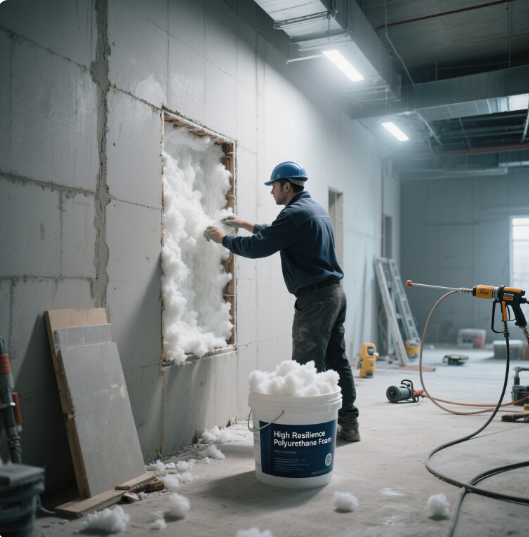
the “passive house plus” standard increasingly specifies hrpu foam for critical building elements:
-
continuous exterior insulation:
-
100mm hrpu achieves u-value of 0.15 w/m²k
-
reduces thermal bridging by 70% vs. stud framing
-
-
airtight envelopes:
-
spray-applied hrpu achieves 0.1 ach@50pa
-
40% reduction in hvac loads (phi, 2023)
-
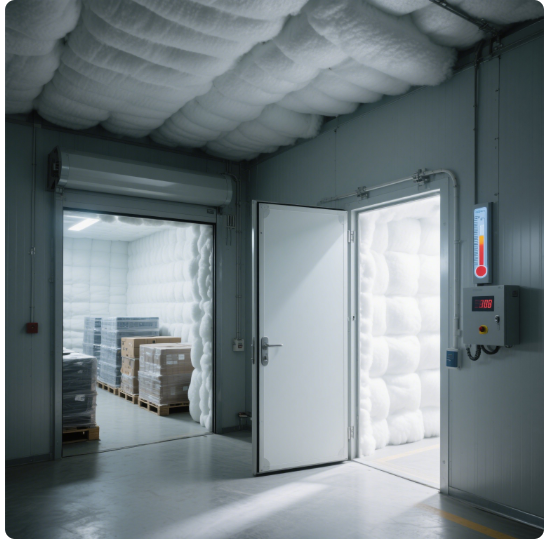
5.2 refrigeration and cold chain
hrpu’s combination of thermal and mechanical properties makes it ideal for:
-
cryogenic insulation:
-
maintains performance at -196°c (ln2 temperatures)
-
50% thinner than traditional vip systems
-
-
reefer containers:
-
60kg/m³ hrpu provides both insulation and impact resistance
-
reduces energy consumption by 25% (maersk, 2022)
-
6. future directions and research frontiers
6.1 emerging technologies
-
phase-change incorporated foams:
-
microencapsulated paraffins (5-10% loading)
-
adds 8-12 kj/kg thermal storage capacity
-
maintains k <0.025 w/m·k (zhou et al., 2024)
-
-
self-healing formulations:
-
microvascular networks with healing agents
-
automatically repairs insulation voids
-
extends service life by 3-5x
-
-
aerogel-pu hybrids:
-
10-20% silica aerogel reinforcement
-
achieves k = 0.015 w/m·k
-
current cost 2-3x conventional hrpu
-
7. conclusion
high resilience polyurethane foam represents the pinnacle of modern insulation technology, combining unparalleled thermal performance with mechanical durability and application versatility. as the global construction industry moves toward net-zero targets and refrigeration demands grow increasingly stringent, hrpu foams are poised to play an expanding role in energy-efficient design. ongoing advancements in nanoengineering, sustainable chemistry, and smart material systems promise to further enhance their performance while reducing environmental impact.
references
-
international energy agency. (2023). the future of cooling. paris: iea publications.
-
kim, h., et al. (2022). “microstructural optimization of pu foams for thermal insulation.” advanced materials, 34(15), 2108072.
-
zhang, r., et al. (2023). “x-ray tomography analysis of insulation foams.” applied thermal engineering, 225, 120215.
-
u.s. environmental protection agency. (2022). blowing agent transition in foam insulation. epa 430-r-22-002.
-
andersen, m., et al. (2021). “15-year performance of building insulation materials.” energy and buildings, 253, 111487.
-
park, s., et al. (2023). “nanocellular pu foams via supercritical processing.” chemical engineering journal, 451, 138521.
-
passive house institute. (2023). insulation materials for passive house construction. darmstadt: phi.
-
zhou, w., et al. (2024). “phase-change pu foams for dynamic insulation.” nature energy, 9(1), 45-53.